


.webp)
The Internet of Things (IoT) refers to a growing network of physical objects that are embedded with sensors, software and connectivity features, enabling them to collect and exchange data. These objects, or ‘things,’ can range from smartwatches and fridges to industrial robots and entire energy grids.
At its core, IoT bridges the physical and digital worlds. Devices not only sense and monitor their environments but also interact with other systems in real-time. As a result, IoT is reshaping industries, powering new digital economies and laying the foundation for emerging technologies such as decentralised infrastructure, AI-driven automation and smart cities, enabling data-based decision-making at every level.
How the Internet of Things Works
To grasp the potential of IoT, it’s essential to understand how its architecture functions in practice. A typical IoT system includes the following components:
1. Connected Devices (Sensors and Actuators)
These are the 'things' in the Internet of Things: physical devices embedded with sensors that collect environmental data such as temperature, motion, or location. Many also include actuators, which perform actions based on system commands -like opening a valve or adjusting a thermostat. Together, these enable full feedback loops between sensing and implementing actions.
2. Network Connectivity
Collected data needs to connect with a central system, which happens via communication protocols such as Wi-Fi, cellular networks, Bluetooth, LoRaWAN (Long Range Wide Area Network), Zigbee (a low-power mesh protocol), or even satellite. These technologies allow devices to send data to cloud systems or edge nodes for real-time responses.
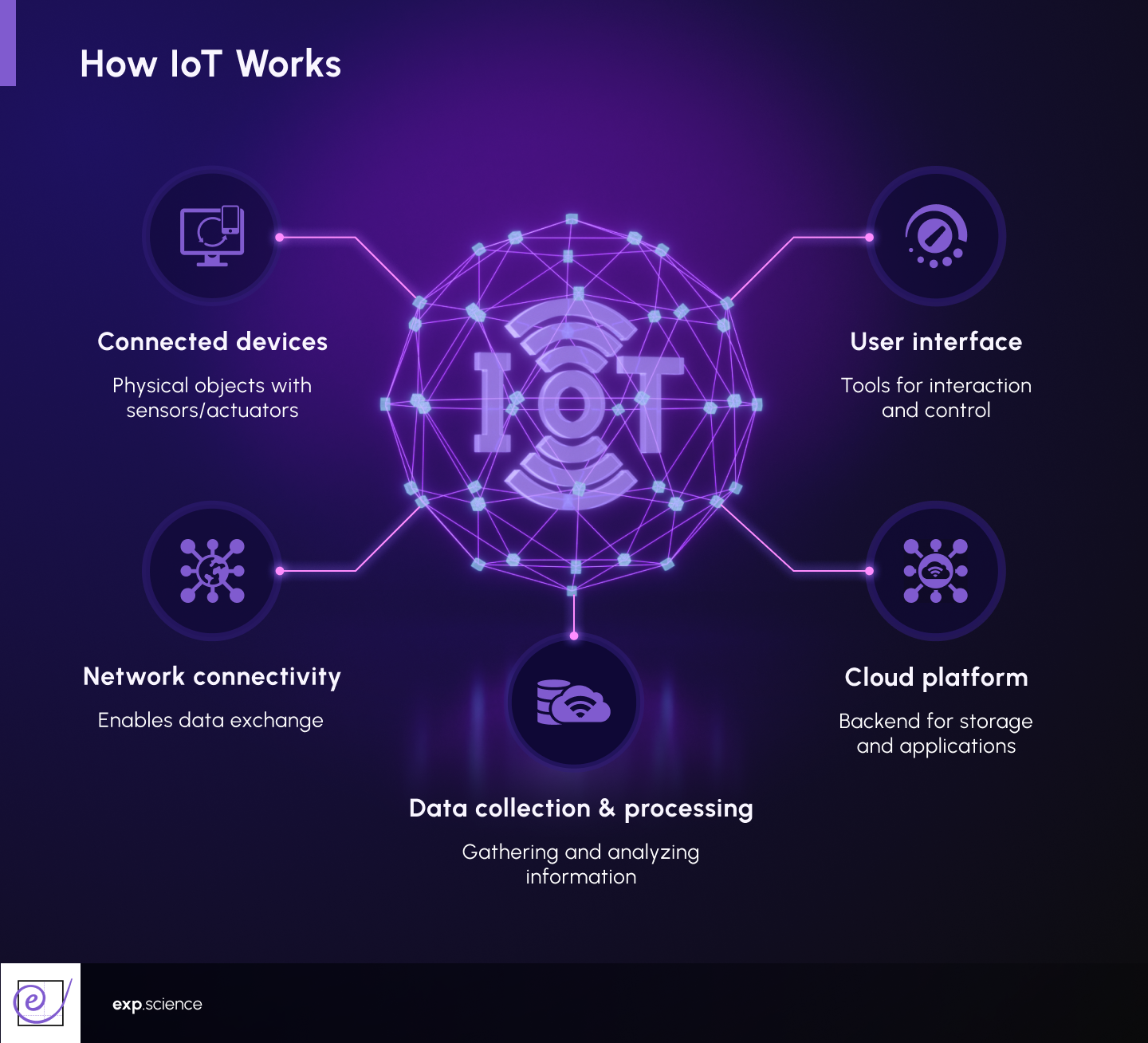
3. Data Processing and Intelligence
Raw data is analysed to detect patterns, generate insights or trigger automated actions. Increasingly, AI and machine learning algorithms are embedded directly in devices (edge AI) or used in cloud platforms to enable predictive maintenance, anomaly detection and automation.
4. Cloud Platforms and Storage
IoT systems typically rely on cloud infrastructure to store data, manage devices and run analytics. The cloud acts as a central hub, supporting device provisioning, software updates and integration with enterprise systems. It also enables scalability and remote access, making it easier to manage large networks of devices from a single interface.
5. User Interfaces
A user interface allows humans or other systems to interact with IoT data in real-time. These may include mobile apps, dashboards or APIs. In smart homes, this means simple control panels; in industrial contexts, advanced visualisations help monitor system health, track assets or trigger interventions. Well-designed interfaces are key to translating complex data into actionable insights.
Benefits and Applications of IoT
IoT's potential spans multiple industries, offering measurable benefits including operational efficiency, data-driven decision-making and new service models. Below are some of the most transformative applications:
Smart Cities
Cities are deploying IoT sensors for traffic flow optimisation, street lighting control, waste management and environmental monitoring. IoT helps urban infrastructure become more responsive, efficient and sustainable. For instance, traffic signals connected to air quality and congestion sensors dynamically adjust light cycles to improve flow and reduce emissions.
Industrial IoT (IIoT)
Factories and logistics centres use IoT to monitor machinery, track assets and improve safety. Predictive maintenance powered by sensor data reduces downtime and lowers operational costs. It is the case of drones with IoT sensors that are used to inspect pipelines or monitor warehouse inventory in real-time.
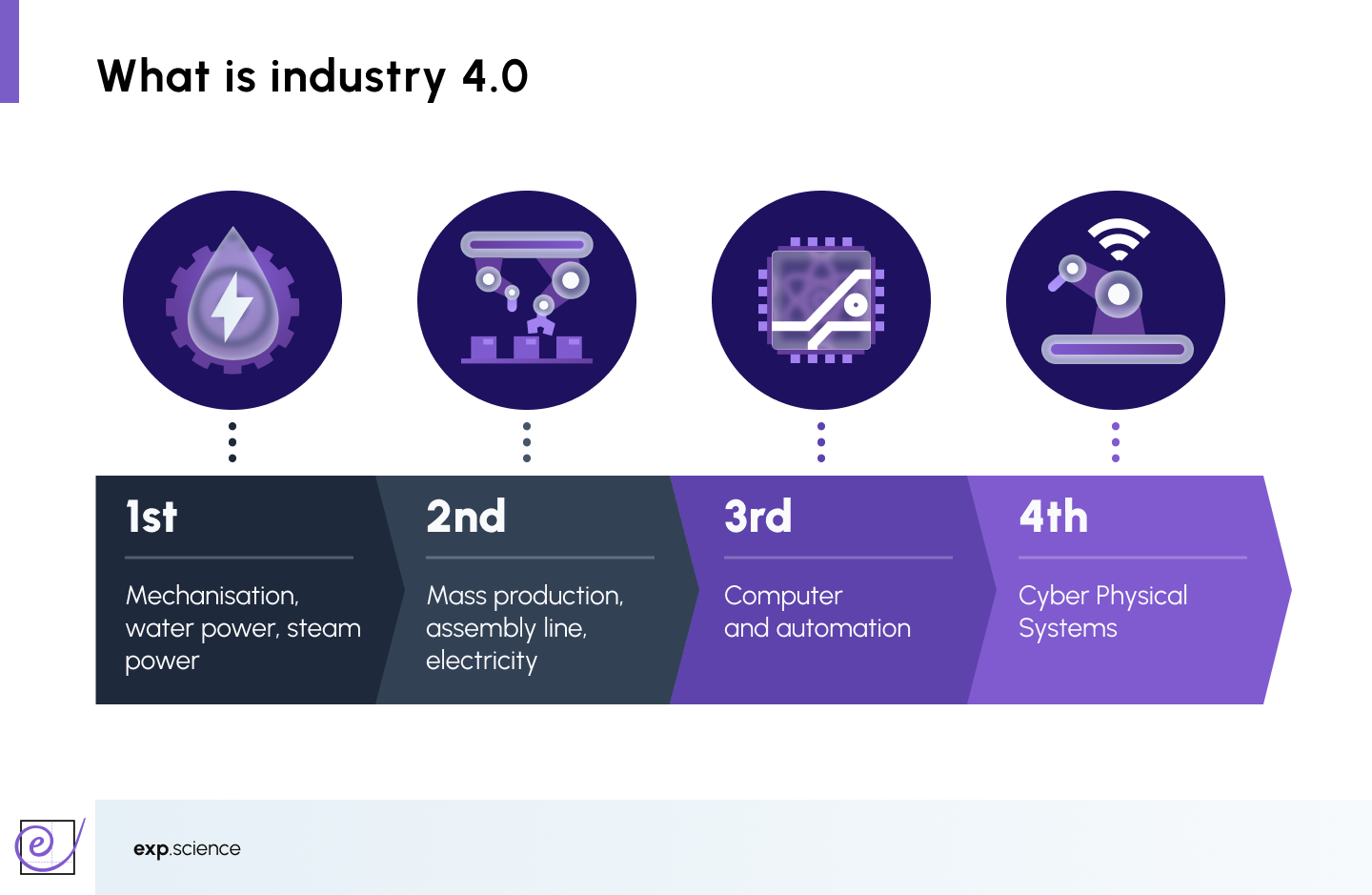
This evolution of industrial environments is part of what's known as Industry 4.0, the fourth industrial revolution, where cyber-physical systems, automation and real-time data define modern manufacturing.
Energy and Utilities
Smart meters and grid sensors optimise electricity and water usage. IoT supports demand-response systems, load balancing and the integration of renewable energy. For example, IoT sensors track electricity usage in real-time to optimise power distribution and detect outages instantly.
Healthcare and Wearables
Wearables and remote-monitoring devices collect health data, improving patient outcomes and enabling telemedicine. IoT is also critical in hospital asset tracking and sanitation compliance. One type of these devices are smartwatches that monitor the heart rate and oxygen levels, and send alerts to health providers in case of anomalies.
Agriculture
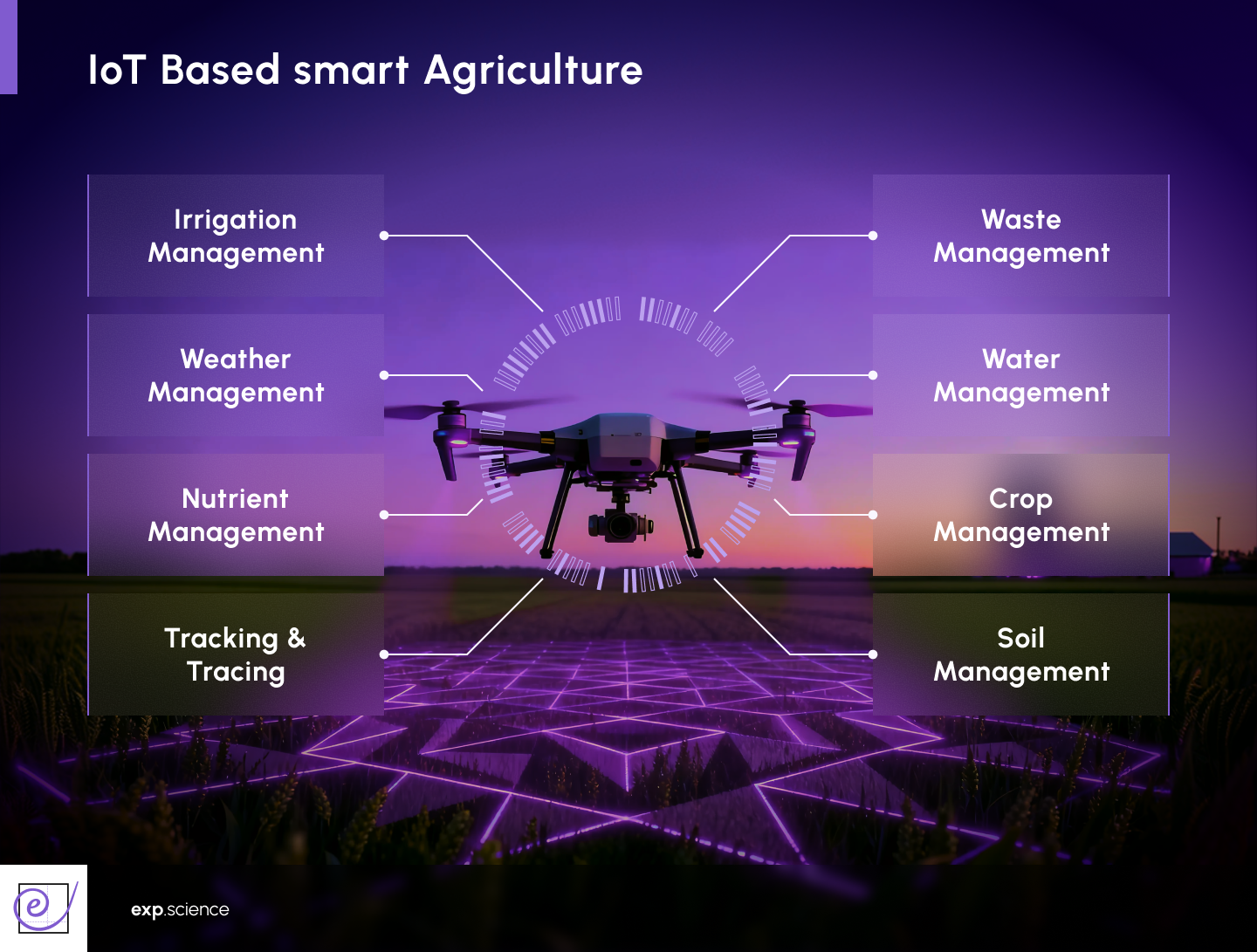
IoT-enabled soil sensors, weather stations and GPS-guided equipment improve crop management. Farmers use real-time data to make better irrigation, fertilisation and harvesting decisions, among other uses. It is the case of connected irrigation systems that automatically adjust water usage based on soil moisture levels and weather forecasts.
Supply Chain And Logistics
Asset tracking sensors and connections to vehicles improve the visibility and security of goods in transit. IoT helps logistics providers respond to delays, theft or spoilage, or allows consumers to verify a product’s journey (including how it was stored and transported), helping them assess its sustainability, ethical sourcing or environmental impact. For instance, cold-chain logistics companies monitor the temperature of shipments in real time and receive alerts if conditions exceed safe thresholds.
IoT and DLTs: A Decentralised Advantage
As the number of IoT devices grows, so do the challenges; particularly around data integrity, security, scalability and device interoperability. This is where distributed ledger technologies (DLT), such as Hedera, can offer significant value by simplifying the process of exchanging and verifying data without the need to spend excessively on the infrastructure.
→ Learn more about What is DLT? Distributed Ledger Technology Explained
1. Data Integrity and Trust
DLTs like Hedera can provide verifiable timestamps for every data point generated by IoT devices. This ensures data integrity and allows organisations to prove the authenticity of information, which is especially critical in sectors like supply chain, finance and healthcare. Avery Dennison, a material sciences and digital identity company, for example, uses Hedera to anchor data from RFID tags and sensors across global supply chains, ensuring each product’s provenance is transparent and tamper-proof.
2. Secure Device Identity
By registering IoT devices using decentralised identifiers (DIDs) anchored to a public DLT, systems can securely manage device identities, prevent spoofing, and ensure only authorised actors can communicate within the network.
3. Micropayments and Machine Economies
Native cryptocurrencies such as HBAR, Hedera’s native token, enable automated micropayments between devices. For example, a vehicle could pay at charging stations or for using the toll systems autonomously per unit of energy or distance travelled, all in real-time, without human intervention.
4. Environmental Sustainability
Unlike energy-intensive blockchains that rely on proof-of-work consensus, Hedera uses a proof-of-stake (PoS) model and asynchronous Byzantine Fault Tolerance (aBFT), making it one of the most energy-efficient public ledgers. It is also carbon-negative, a key consideration for large-scale IoT deployments prioritising sustainability.
IoT: Benefits Versus Challenges
IoT brings many benefits to different industries, but it also comes with some trade-offs that need to be addressed to unlock its full potential.
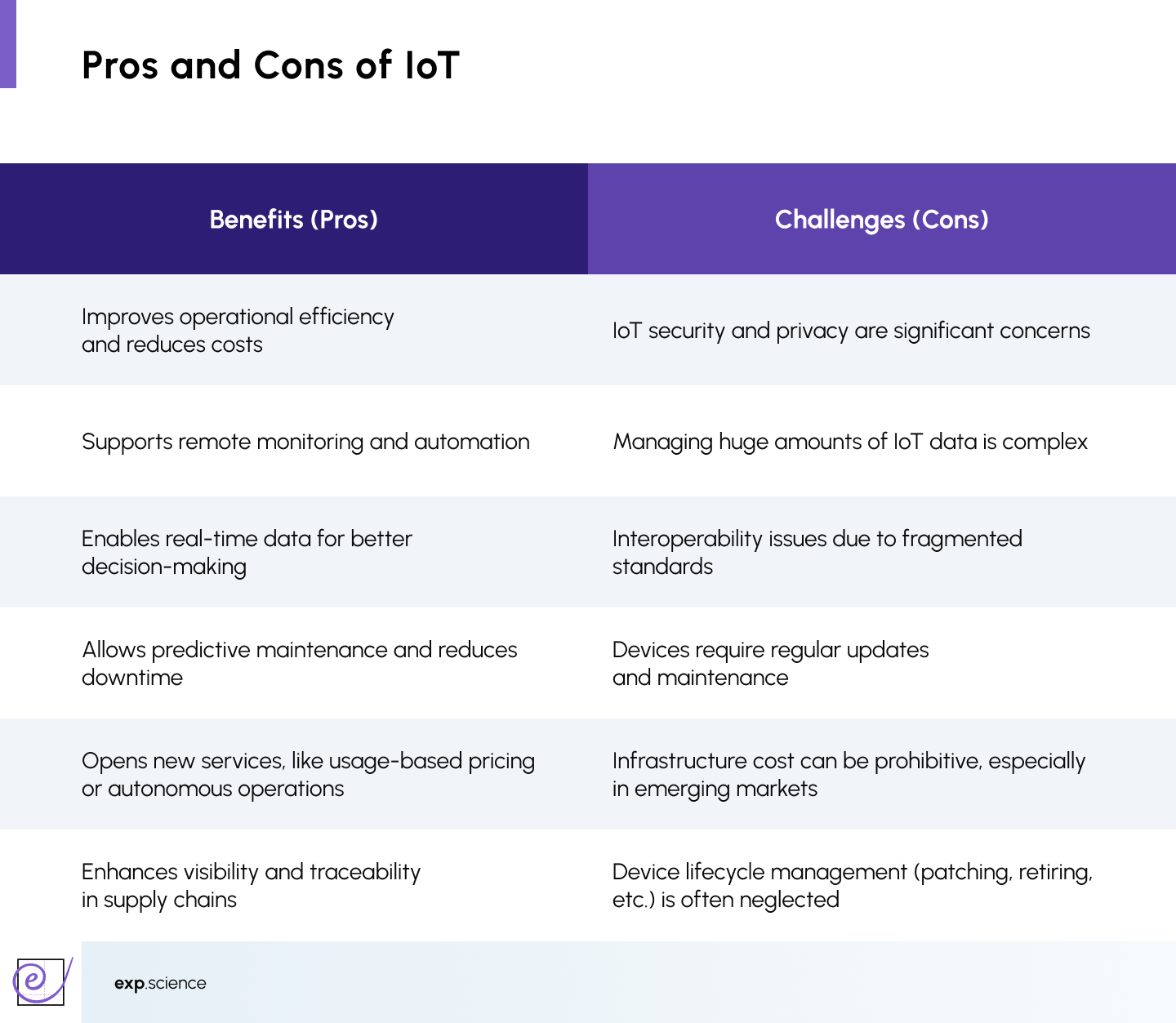
IoT brings strong advantages across industries, from reducing downtime to unlocking new services and improving visibility. Real-time data collection enables predictive maintenance, while automation cuts manual effort and boosts precision. However, challenges remain: devices must be secured, standards need alignment, and data overload can strain infrastructure. Overcoming these hurdles is essential to scale IoT in a secure, sustainable and efficient way.
Key Technologies Driving IoT Growth
The continued rise of IoT is made possible by a wave of converging technologies:
- 5G and LPWAN (Low-Power Wide Area Network): These networking technologies provide the necessary speed, reach and energy efficiency to connect billions of devices simultaneously, from smart sensors in farms to autonomous fleets in cities.
- Edge Computing: Shifts computation closer to the data source, reducing latency, lowering bandwidth use and enabling real-time decision-making in industrial, medical and safety-critical contexts.
- AI and Machine Learning: These technologies enable devices to self-learn, self-correct and predict outcomes, from forecasting failures in machinery to optimising energy use in real time.
- Blockchain and DLTs: Provide decentralisation, tamper-proof records, device identities, programmable logic and trusted automation, forming the trust layer for IoT.
- Sensor and Chip Miniaturisation: Advances in hardware make it possible to embed intelligence into tiny, cheap and power-efficient devices, expanding the potential use cases and lowering entry barriers.
- Interoperability Standards: Open protocols such as MQTT (Message Queuing Telemetry Transport), CoAP (Constrained Application Protocol), and OPC UA (Open Platform Communications Unified Architecture) allow different IoT devices and platforms to communicate seamlessly, a vital factor in enterprise adoption and cross-industry integration.
→ Explore how these technologies interwine here Blockchain, AI and Sustainability: How Emerging Technologies Converge
IoT Development Outlook
The Internet of Things is transforming how the world works, bringing intelligence, automation and measurable outcomes to the physical world. Whether managing energy grids, monitoring soil health or tracking hospital equipment, IoT is unlocking real-time control and new economic models.
As billions more devices come online, the ability to ensure secure, scalable, and interoperable infrastructure becomes crucial. Decentralised Technologies like Hedera offer promising foundations for managing this complexity, delivering trusted data flows, autonomous micropayments and sustainable scale.
In the end, IoT is not just about smart devices; it’s about building an intelligent, interconnected world, one sensor at a time. The convergence of IoT with distributed systems, AI, tokenisation and edge computing is laying the groundwork for resilient, transparent infrastructure. As new governance models and trust frameworks emerge, IoT will play a central role in shaping how society interacts with technology, and how digital value is created, exchanged and secured.

.jpg)

.jpeg)
.jpg)

