


.jpg)
Stablecoins are digital tokens designed to maintain a stable value relative to a reference asset, most commonly the U.S. dollar, but also other fiat currencies or commodities like gold. Traditional cryptocurrencies like Bitcoin and Ethereum are known for their dramatic price swings, which makes them impractical for everyday purchases. Stablecoins were designed to address this problem by offering the advantages of digital currency while maintaining steady value, making them much more suitable for daily transactions.
The primary problem stablecoins address is the volatility inherent in most cryptocurrencies. Early cryptocurrency adoption was hindered by dramatic price swings that made these digital assets impractical for everyday transactions, merchant payments, or as stores of value. Stablecoins offer the technological advantages of blockchain, such as programmability, 24/7 availability, and borderless transfers, while maintaining the predictable value that users expect from money. In essence, they represent an attempt to combine the innovation of cryptocurrency with the stability of traditional currency.

Traditionally, currency stability has been maintained through central bank policies and government backing. Stablecoins use existing traditional finance theory and concepts from Money Market Funds (MMFs) in their approach to managing reserves and maintaining a one-to-one peg with a specific fiat currency, most often the US dollar.
The current stablecoins with the most market share, such as Circle’s USDC and Tether’s USDT, maintain asset-backed reserves similar to traditional MMFs, but add a crucial innovation: tokenisation enables instant, transparent transfer of ownership on blockchain networks. This represents an evolution of existing financial instruments, where trust remains anchored in tangible reserves while blockchain technology provides enhanced transparency and programmability.
By contrast, stablecoins that have attempted to maintain their peg through purely algorithmic systems have experienced the most severe failures, demonstrating that successful digital currencies still require the foundation of real-world assets and institutional accountability.
History of Stablecoins
The concept of stablecoins emerged from the early cryptocurrency community's recognition that price volatility was a fundamental barrier to widespread adoption. The first serious attempt at creating a stable digital currency was BitUSD, launched in 2014 by the BitShares platform. BitUSD was backed by collateral in the form of BitShares tokens and used smart contracts to maintain its dollar peg.
However, the stablecoin that gained significant traction was Tether (USDT), launched in 2014, Tether was originally marketed as having full backing by U.S. dollars held in reserve, offering a simple proposition: each USDT token represented one US dollar held in a bank account.
Since 2019, Tether has revised its reserve disclosure: USDT is now backed with a mix of cash, cash equivalents (such as U.S. Treasury bills), and other assets like commercial paper, corporate bonds, precious metals, and Bitcoin.
The rapid development of stablecoins demonstrates how digital innovation can accelerate the evolution of monetary concepts that have remained relatively static for decades. Stablecoins have swiftly progressed from experimental tokens to infrastructure supporting hundreds of billions of dollars in economic activity.
Types of Stablecoins
Stablecoins can be categorised into several types based on their underlying mechanisms for maintaining price stability. Each approach represents a different philosophy about how to achieve stability in a decentralised digital environment.
- Fiat-Backed Stablecoins Fiat-backed stablecoins are the most straightforward and widely adopted type. They maintain their peg by holding reserves of traditional fiat currency or equivalent assets for each token in circulation. This model closely resembles electronic money or digital cash because each token represents a direct claim on underlying fiat reserves.
- USDT (Tether) remains the largest stablecoin by market capitalisation. Despite ongoing questions about its reserve composition and transparency, USDT has maintained its peg and remains a dominant stablecoin by global trading volume and regularly publishes reserve disclosures.
- USDC (USD Coin) is backed by a consortium including Coinbase and Circle. USDC has approximately $73 billion in market capitalisation and emphasises regulatory compliance and regular attestations of its reserves.
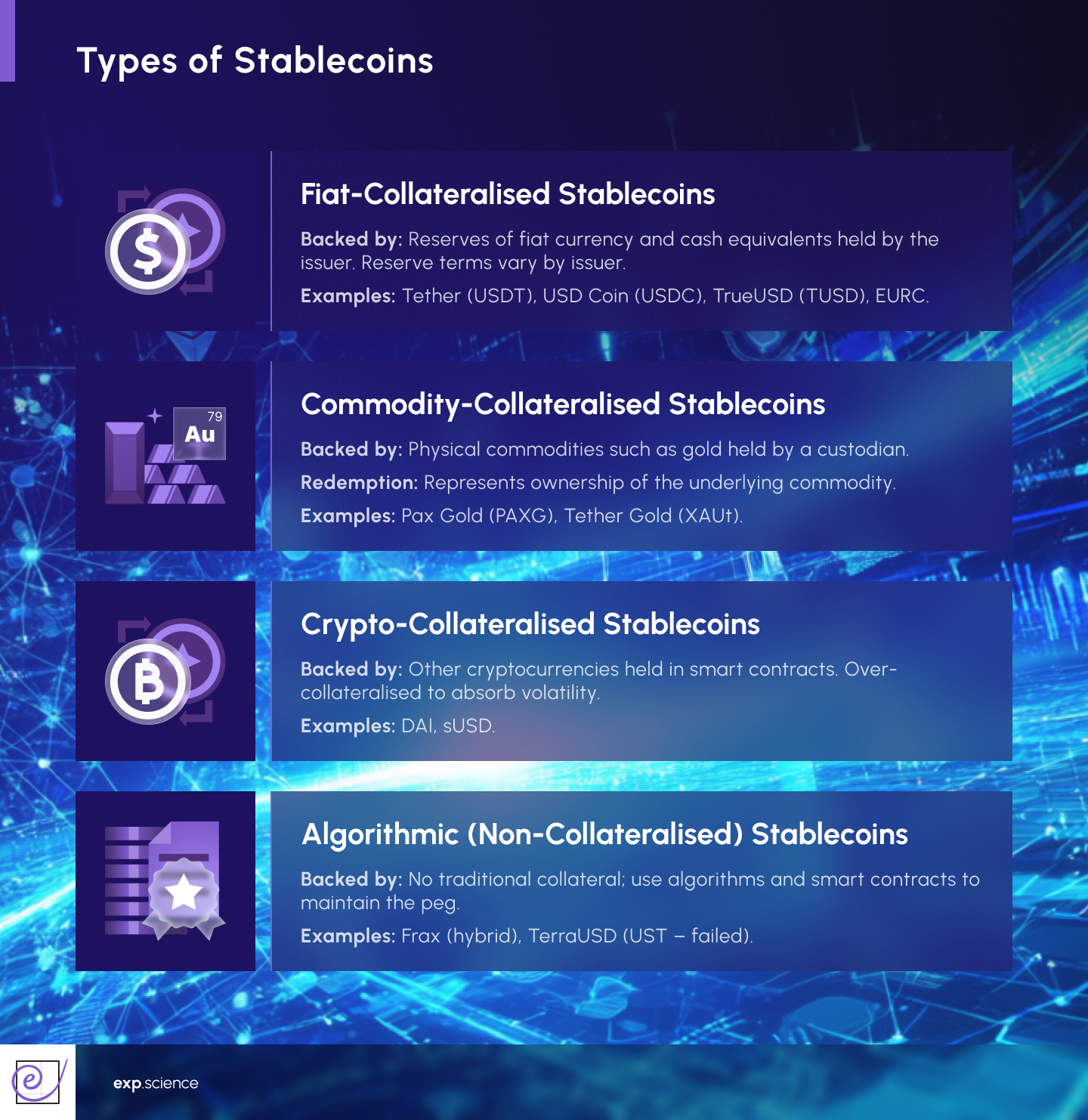
These fiat-backed stablecoins often rely heavily on U.S. government debt securities, particularly Treasury bills, as part of their reserve assets. This creates a dynamic where private stablecoin issuers become significant holders of government debt, essentially digitising portions of the traditional monetary system.
Commodity-Backed Stablecoins
Commodity-backed stablecoins represent digital ownership of physical assets, most commonly precious metals. PAX Gold (PAXG) is an example, where each token represents ownership of one troy ounce of gold stored in professional vaults. Another example is Diamond Standard, which allows buyers to invest in diamonds starting from only $25.
These types of stablecoins face unique challenges around storage, insurance, and verification of underlying assets. They must bridge the gap between physical commodities and digital tokens, requiring robust systems for custody and audit.
Algorithmic Stablecoins
Algorithmic stablecoins attempt to maintain stability without traditional collateral, instead relying on smart contracts and token economics to manage supply and demand. This approach is the clearest expression of the idea of creating stable value in a fully decentralised way.
The most significant example and cautionary tale is the Terra Luna ecosystem, which collapsed dramatically in May 2022, with over $450 billion in crypto asset value vanishing. TerraUSD (UST) attempted to maintain its dollar peg through an algorithmic relationship with Luna tokens. When demand for UST fell, the protocol would mint new Luna tokens to buy and burn UST, theoretically supporting the price.

The Terra Luna incident offers a profound lesson about the fragility of algorithmic systems and the limits of financial engineering. Despite billions of dollars in value and widespread adoption, the system entered a death spiral when market confidence wavered. The collapse highlighted that algorithmic stability mechanisms, no matter how clever, remain vulnerable to extreme market conditions and shifts in collective confidence.
This failure demonstrates that whilst technology can create new forms of value and stability, it cannot entirely eliminate the fundamental role of trust in monetary systems. The pursuit of purely decentralised stability remains an ongoing challenge in stablecoin design.
Stablecoin Adoption and Market Landscape
The stablecoin market has experienced remarkable growth, with total market capitalisation exceeding $293 billion across all stablecoins as of September 2025. This represents not merely the adoption of a new technology, but the emergence of a parallel monetary system that operates alongside traditional finance.
Current Market Landscape
The market is dominated by a few major players, reflecting both network effects in digital payments and the critical importance of liquidity and trust in monetary systems. Stablecoin adoption varies significantly across different user groups:
- Cryptocurrency traders use stablecoins as a safe harbour during market volatility and as a base currency for trading pairs
- Cross-border payment users increasingly rely on stablecoins for faster, cheaper international transfers, especially in regions with limited banking infrastructure or unstable currencies
- DeFi participants use stablecoins as collateral for lending, liquidity in automated market makers, and stable units of account
Stablecoins vs. Fiat Currency
Stablecoins and fiat currencies are both forms of money, but they operate in different ways. Fiat currencies, such as the pound, dollar, or euro, are issued and controlled by governments and central banks. Stablecoins are digital tokens designed to mirror the value of a fiat currency or other stable asset, but they exist entirely on blockchain networks.

This means stablecoins can move globally at the speed of the internet without relying on banks or payment intermediaries. Stablecoins offer several advantages over traditional fiat currencies:
- 24/7 availability means transactions can happen at any time, unlike the traditional banking systems, which are restricted by business hours and settlement delays
- Programmability enables automatic payments, recurring transfers, and integration with smart contracts
- Lower costs and faster transfers are achieved by cutting out intermediaries, with stablecoins fcilitating cross-border payments far cheaper and quicker. In contrast, services such as SWIFT or Western Union often charge high fees and take days to settle transactions
- Global accessibility since anyone with an internet connection can use stablecoins, even in places where local banking services are limited or unreliable
- Protection against inflation in countries facing currency instability, as people are increasingly turning to stablecoins as a way to preserve value when local money rapidly loses purchasing power
What's the Difference Between Digital Cash and Stablecoins?
Whilst both enable digital transactions, stablecoins and digitised cash operate through fundamentally different mechanisms. Digitised cash, issued directly by banks, maintains a straightforward relationship between sender, receiver, and the banking institution that issues, redeems, and validates transactions.
Stablecoins introduce multiple additional intermediaries: miners or validators verify transactions on the blockchain, exchanges facilitate redemption between stablecoins and fiat currency, and crypto companies issue the tokens themselves.
The key distinction lies in architectural simplicity versus complexity, digitised cash operates within existing banking infrastructure with direct issuer relationships, whilst stablecoins distribute verification across blockchain networks.

Government and Regulatory Experiments
Governments and regulatory bodies worldwide are increasingly engaging with stablecoins, ranging from cautious oversight to active experimentation with their own digital currency initiatives. These efforts represent a fascinating intersection between traditional monetary authority and blockchain innovation.
As policymakers navigate this emerging landscape, initiatives like the Government Blockchain Academy, a collaboration between the United Nations Development Programme and Exponential Science, are bridging the knowledge gap for government officials. The programme equips regulators and public sector decision-makers with a foundational understanding of blockchain technology and digital currencies, covering critical areas from digital finance to transparent governance, enabling more informed policy development as nations explore stablecoin frameworks and digital currency initiatives.
Wyoming, USA: The WYST Initiative
Wyoming has positioned itself as a cryptocurrency-friendly jurisdiction through progressive legislation and innovative pilot programmes. The state has explored launching its own stablecoin initiative, though specific details about WYST (Wyoming Stable Token) implementation remain in development phases. The concept involves creating a state-backed stablecoin that could potentially generate revenue for the state whilst promoting blockchain innovation.
Wyoming's approach emphasises the use of blockchain technology, with Hedera being considered as a potential platform due to its energy efficiency and regulatory-friendly features. The state's exploration of Treasury-backed digital assets reflects a broader trend of governments considering how blockchain technology might enhance their financial infrastructure while maintaining regulatory oversight.
This initiative represents a significant development: rather than simply regulating private stablecoins, Wyoming is exploring how government entities might directly participate in the digital asset ecosystem. Such projects could serve as templates for other jurisdictions considering similar approaches.
Palau: Partnership with Ripple
The Republic of Palau has partnered with Ripple to develop a U.S. dollar-backed digital currency pilot programme. This initiative, often described as a quasi-central bank digital currency (CBDC), aims to modernise Palau's financial infrastructure whilst maintaining the stability of US dollar backing.
The Palau Stablecoin represents an interesting hybrid approach: whilst technically a stablecoin backed by U.S. dollars, it's issued with government support and designed to serve some functions traditionally associated with national currency. This model may appeal to smaller nations seeking to modernise their monetary systems without developing entirely new currencies.
The project emphasises financial inclusion and efficiency, particularly for cross-border transactions and digital payments. For a small island nation, blockchain-based currency systems could provide access to advanced financial infrastructure that might otherwise be prohibitively expensive to develop independently.
Broader Government Interest
Beyond specific projects, governments worldwide are studying stablecoins as both potential threats to monetary sovereignty and opportunities for innovation. Some view privately-issued stablecoins as competition to national currencies, while others see them as useful financial infrastructure that can coexist with traditional systems.
These experiments reflect a broader recognition that digital currencies are not merely technological curiosities but potentially transformative financial infrastructure. Governments that engage constructively with blockchain technology may be better positioned to influence its development and ensure it serves public interests.
Regulation and Oversight
The regulatory landscape for stablecoins remains dynamic and varies significantly across jurisdictions, reflecting different approaches to balancing innovation with financial stability and consumer protection.
United States Regulatory Approach
U.S. regulators have taken an increasingly active interest in stablecoins, with multiple agencies asserting jurisdiction over different aspects of their operation. The Treasury Department, the Federal Reserve, the Office of the Comptroller of the Currency, and the Securities and Exchange Commission all have potential oversight roles.
Key regulatory concerns include reserve backing verification, anti-money laundering compliance, systemic risk management, and consumer protection. Regulators worry that large-scale stablecoin adoption could create new forms of systemic risk if issuers cannot meet redemption demands during market stress.
The GENIUS Act (Guiding and Establishing National Innovation for U.S. Stablecoins) was signed into law in July 2025, establishing the first comprehensive federal framework for stablecoins, requiring one-to-one reserve backing with U.S. dollars or low-risk assets, monthly audits, and clear licensing requirements for both bank and non-bank issuers.
European Union Framework
The European Union has developed comprehensive regulatory frameworks for digital assets, including specific provisions for stablecoins under the Markets in Crypto-Assets (MiCA) regulation. These rules establish requirements for authorisation, reserve management, and operational standards for stablecoin issuers.
The EU approach emphasises consumer protection and market integrity while attempting to provide regulatory clarity that could encourage innovation within a controlled framework. Stablecoin issuers must meet capital requirements, maintain adequate reserves, and provide regular reporting to supervisory authorities. Meeting these guidelines can be challenging. Independent organizations like the MiCA Crypto Alliance are on the frontline, engaging with regulators to provide clarity to the ecosystem, maintaining compliance trackers and resources such as whitepaper templates to support projects navigating these requirements.
Global Regulatory Coordination
International bodies such as the Financial Stability Board and Bank for International Settlements have issued guidance on stablecoin regulation, recognising that these digital assets operate across borders and require coordinated oversight approaches.
Other countries, such as Singapore, Switzerland, and the UK, have also developed regulatory frameworks for stablecoins. Singapore's MAS requires licensing and reserve management standards, Switzerland offers clarity through its financial market infrastructure laws. The UK's FCA and Bank of England are jointly implementing regulations treating payment stablecoins like traditional payment systems.
The challenge for regulators is to develop frameworks that address legitimate concerns about financial stability and consumer protection, whilst preserving the benefits that stablecoins offer. Overly restrictive regulation could stifle innovation, whilst insufficient oversight might allow systemic risks to develop.
A Stable Path Ahead
Stablecoins have evolved from experimental tokens to critical financial infrastructure. Their success lies not in replacing traditional money but in bridging the gap between legacy financial systems and digital innovation. The Terra Luna collapse demonstrated that technological sophistication cannot eliminate the need for trust in monetary systems. Meanwhile, the resilience of fiat-backed stablecoins demonstrates that hybrid approaches combining blockchain efficiency with traditional asset backing can create genuinely useful financial tools.
As governments worldwide develop regulatory frameworks and explore their own digital currencies, stablecoins may prove to be the training ground for broader monetary digitisation. They have already demonstrated that programmable money with global accessibility is not just possible but practically valuable.
The stablecoin story is ultimately about the evolution of money itself. Whether they represent the future or merely a bridge to it, they have permanently changed how we think about digital value, cross-border payments, and the relationship between technology and trust in financial systems.

.jpg)

%20(1).jpg)
.webp)

