


.webp)
Regenerative Finance (ReFi) represents a transformative vision for global finance that seeks to shift financial systems from extraction to restoration by prioritising environmental regeneration and social equity. Grounded in blockchain technology and decentralised tools, ReFi aligns economic incentives with ecological and social well‑being, driving systemic change in a world grappling with climate crises, inequality, and unsustainable practices.
To fully appreciate what makes ReFi distinct, and how it contributes to the broader Web3 movement, it is worth placing it in context alongside related frameworks such as Decentralised Finance (DeFi) and Decentralised Science (DeSci). The three combining set the stage for a deeper understanding of ReFi’s purpose and potential.
Putting Into Perspective: DeFi, ReFi and DeSci
Each of these movements positions decentralisation to address different systemic challenges:
- Decentralised Finance (DeFi): Democratises access to financial services via blockchain‑based money markets, lending, insurance and trading.
- Regenerative Finance (ReFi): Channels financial flows towards ecological restoration, climate resilience and social inclusion.
- Decentralised Science (DeSci): Reimagines scientific research funding and collaboration through openness, transparency and decentralised funding mechanisms.
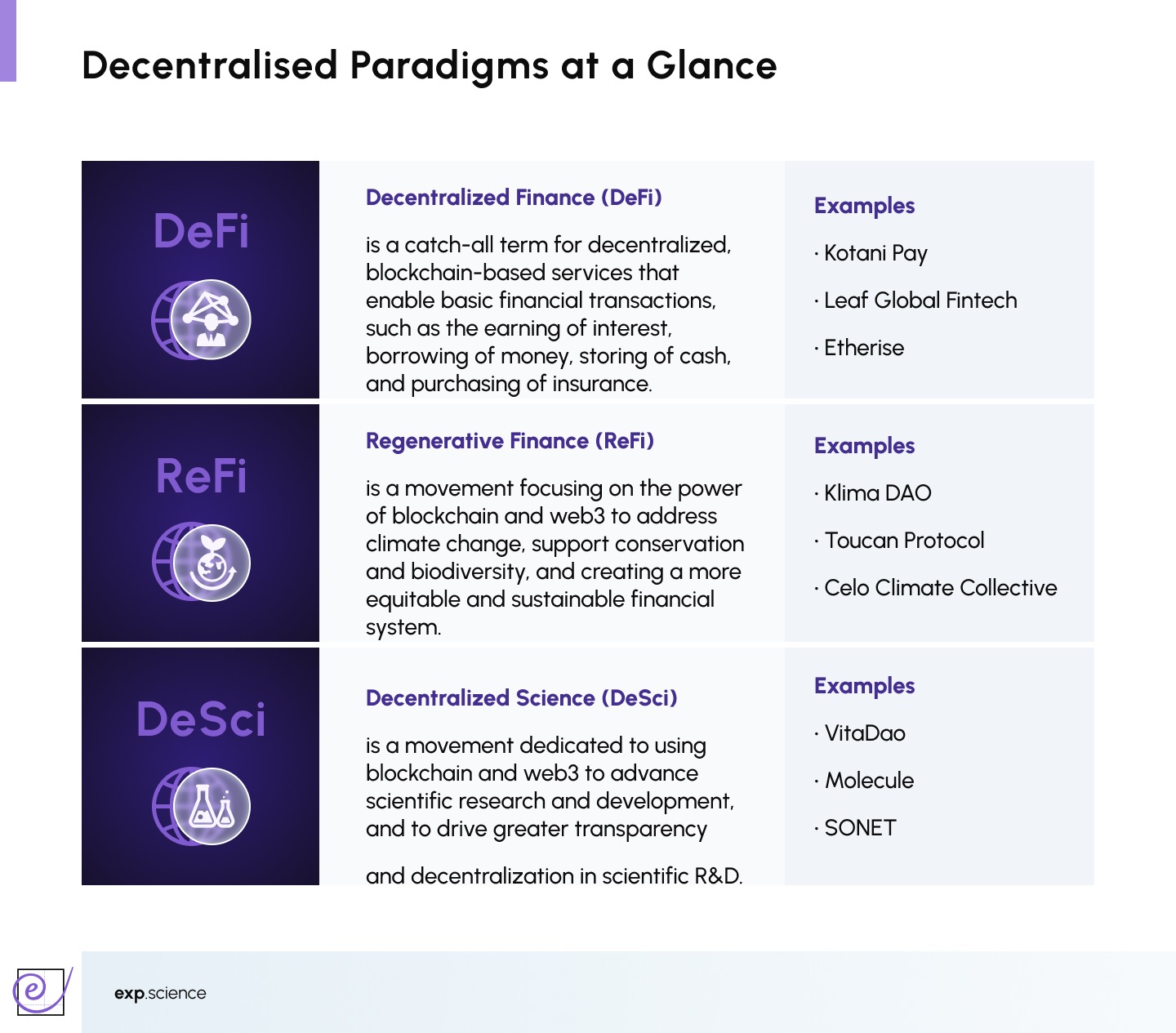
This comparison demonstrates that ReFi stands apart from DeFi and DeSci not merely by its objectives, but by its emphasis on impact, ecological outcomes and regenerative value creation beyond traditional financial utility.
🔗 Read also: What is Decentralised Science? DeSci as a New Era in Research
What is ReFi Definition?
At its core, Regenerative Finance integrates economic systems with the principles of regeneration, aiming to restore ecosystems and uplift communities. Unlike traditional finance, which often prioritises short‑term profits and shareholder returns, ReFi channels capital into projects that deliver long‑term positive economic, social, and environmental impact.
Key objectives of ReFi include:
- Long‑Term Vision: Financing projects that provide lasting ecological and societal benefits rather than short‑term monetary gains.
- Community Empowerment: Building inclusive financial systems that promote equity and uplift underserved populations.
- Ecological Restoration: Directing investments toward activities such as reforestation, carbon sequestration, biodiversity conservation and habitat protection.
ReFi is inherently interdisciplinary, blending economics, ecology, decentralised governance and open technology development. Using decentralised ledger technologies, open governance structures and transparent measurement tools, ReFi enables stakeholders, from farmers to scientists and policymakers, to co‑design solutions that generate measurable positive impact and resilience.
For example, ReFi initiatives may fund regenerative agriculture projects that improve soil health, carbon credit platforms that enhance transparency in emissions offsetting, or renewable energy solutions that drive sustainable energy adoption in underserved regions.
Core Traits of ReFi
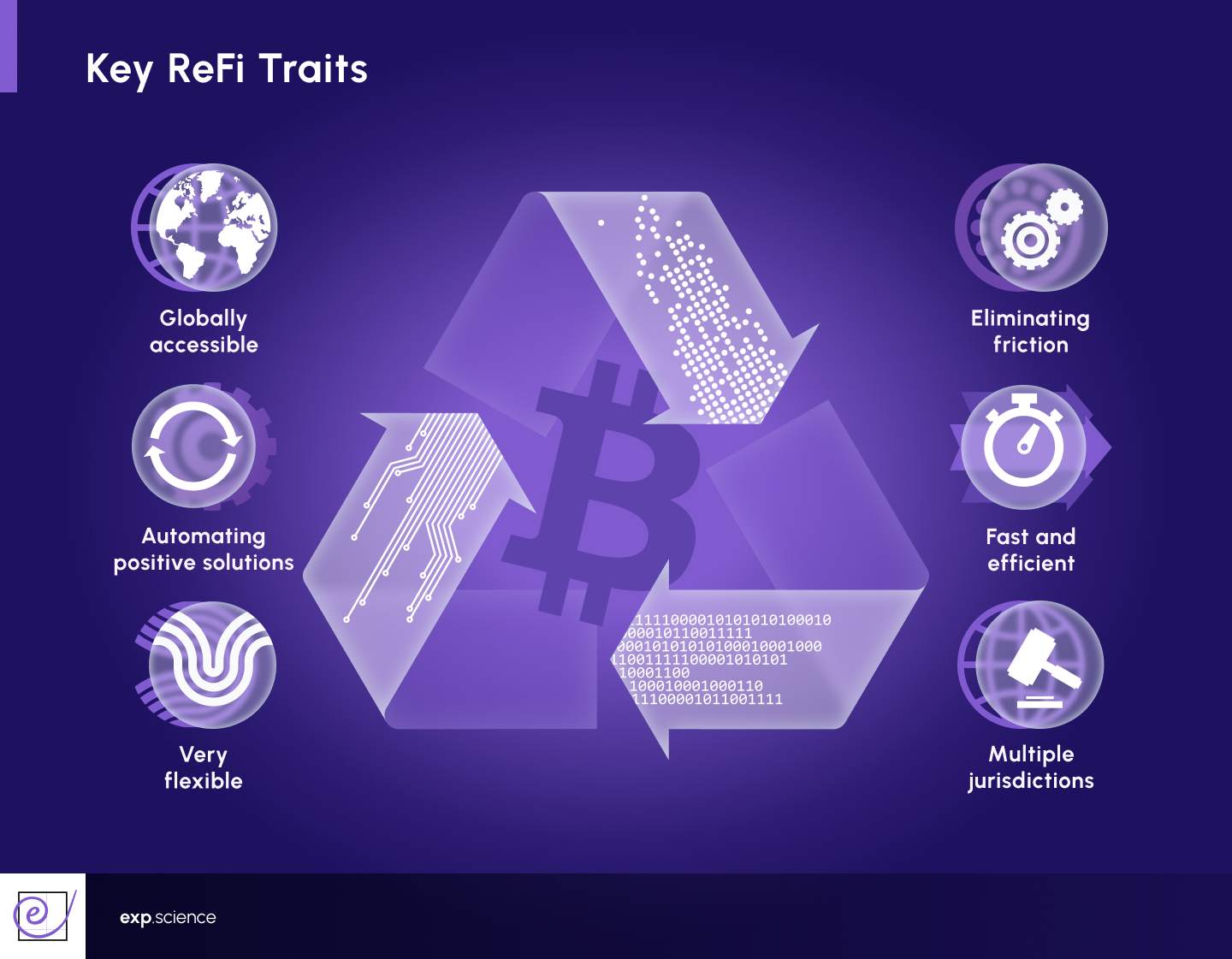
ReFi embodies distinct traits that differentiate it from traditional finance and other decentralised systems:
- Globally Accessible: Ensuring financial systems are available to all, irrespective of geography.
- Automation of Positive Solutions: Using smart‑contract automation to implement and scale regenerative initiatives.
- Very Flexible: Adaptable to local context, community needs and evolving environmental conditions.
- Eliminating Friction: Creating seamless financial ecosystems that reduce inefficiencies.
- Fast and Efficient: Leveraging blockchain to enable quick, transparent transactions and governance.
- Multi‑Jurisdictional: Operating across borders to address global challenges collaboratively.
The ReFi Ecosystem: Infrastructure and Innovation
ReFi is not a single protocol or platform, but an ecosystem of tools, applications and governance models. Its core infrastructure is enabled by decentralised ledger technologies (DLT), with protocols running on networks such as Ethereum, and increasingly Hedera: a high‑throughput, low‑energy public ledger used in climate‑related and ESG data applications.
→ Learn more about What is Hedera Hashgraph and How Does HBAR Work?
Some essential ReFi infrastructure elements include:
- Carbon & Biodiversity Protocols:
There have been multiple protocols focused on enabling a series of crypto-focused incentives historically, including Klima Dao, Toucan Protocol, & Regen Network. As the market has matured since its rise from 2017 to 2021, many of the participants have evolved. The Hedera ecosystem, as highlighted on DLT Earth, an initiative of Exponential Science, has approached carbon and biodiversity markets differently as an interconnected series of open source “Sustainable Impact Studios” with full traceability for both finance and data integrity. This approach allows for builders to understand the interworking and economics of the traditional market, marrying web2 traditional financial systems with web3 foundation in; sustainable finance, project treasury finance, registry systems, and methodology digitalization. This approach has enabled multiple traditional Carbon Standards & Registries to adopt Hedera, including market leader Verra, BCarbon, and EcoMarkets Australia, the Registry for Australia’s Great Barrier Reef Credits. These systems address issues that traditional environmental credit markets have historically faced, such as permanence, double counting and auditability. - Impact DAOs:
Governance‑driven funding collectives support projects that deliver public and planetary goods. For instance, the Celo Climate Collective coordinates funding for climate resilience initiatives in the Global South, leveraging pooled resources and community governance to support high‑impact outcomes. Others, such as Straatos within the Hedera ecosystem, are building tools like their Cui Bono platform to better trace funds to communities, while enabling community-based governance for project finance. - dMRV Systems (Digital Measurement, Reporting and Verification):
These platforms integrate IoT sensors and AI‑driven analytics to automate environmental data collection and reporting. In doing so, they bring transparency to project outcomes and ensure that regenerative initiatives deliver verifiable results. On Hedera, organisations such as Hyphen Global and Blockchain for Energy are enabling Hedera Guardian-based systems to track and validate environmental impact in real time.
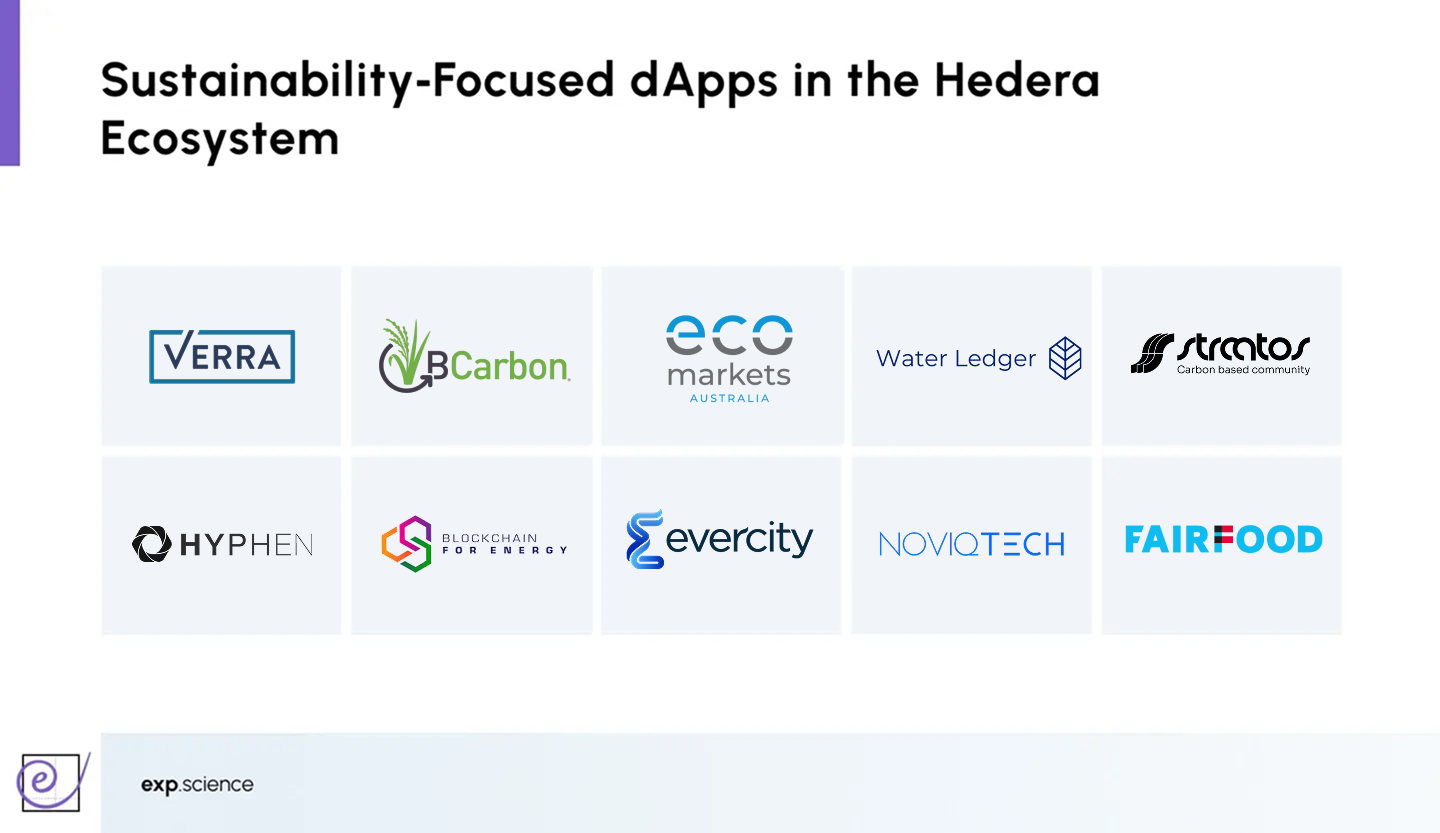
To explore the growing network of projects and organisations building on Hedera, visit Exponential Science’s Hedera Ecosystem Map: https://www.exp.science/hedera-ecosystem or case studies on DLT Earth.
Real‑World Use Cases for ReFi
ReFi’s transformative potential is evident across multiple sectors. Let’s explore some notable use cases:
- Renewable Energy Financing
Blockchain platforms like Energy Web support investments in renewable energy projects, promoting cleaner energy sources and decentralised energy systems. Community solar initiatives, for example, allow individuals to fund solar panel installations and share in the benefits of local energy generation. - Regenerative Agriculture
Regen Network is one of the projects focusing on biodiversity and ecological asset markets, supporting a wider range of nature-based outcomes beyond farming alone. Within Hedera ecosystem, new initiatives are bringing ReFi into additional real-world sectors. One of the prominent examples is Water Ledger Global, which is developing transparent water markets that help measure, verify and trade water stewardship outcomes, while another project, Fairfood, applies distributed ledger technology to trace ethical sourcing and improve sustainability across agricultural commodity supply chains. - Circular Economy Models
ReFi supports circular economy initiatives by financing projects that recycle materials, minimise waste and trace supply chains. Distributed ledgers, such as Hedera’s consensus service, allow products to carry immutably verifiable lifecycle data, enabling consumers and businesses to choose sustainably. For example, MMCM is building a Hedera-powered ecosystem for end-of-life vehicle recycling that tracks materials, enables environmentally responsible scrapping, and generates verifiable credits from automotive circularity.
These examples are only the beginning. As the ecosystem matures, ReFi has the potential to integrate with climate insurance, nature‑backed stablecoins, and public funding programmes, unlocking new forms of capital coordination for climate‑positive initiatives.
ReFi Versus DeFi: A Key Comparison
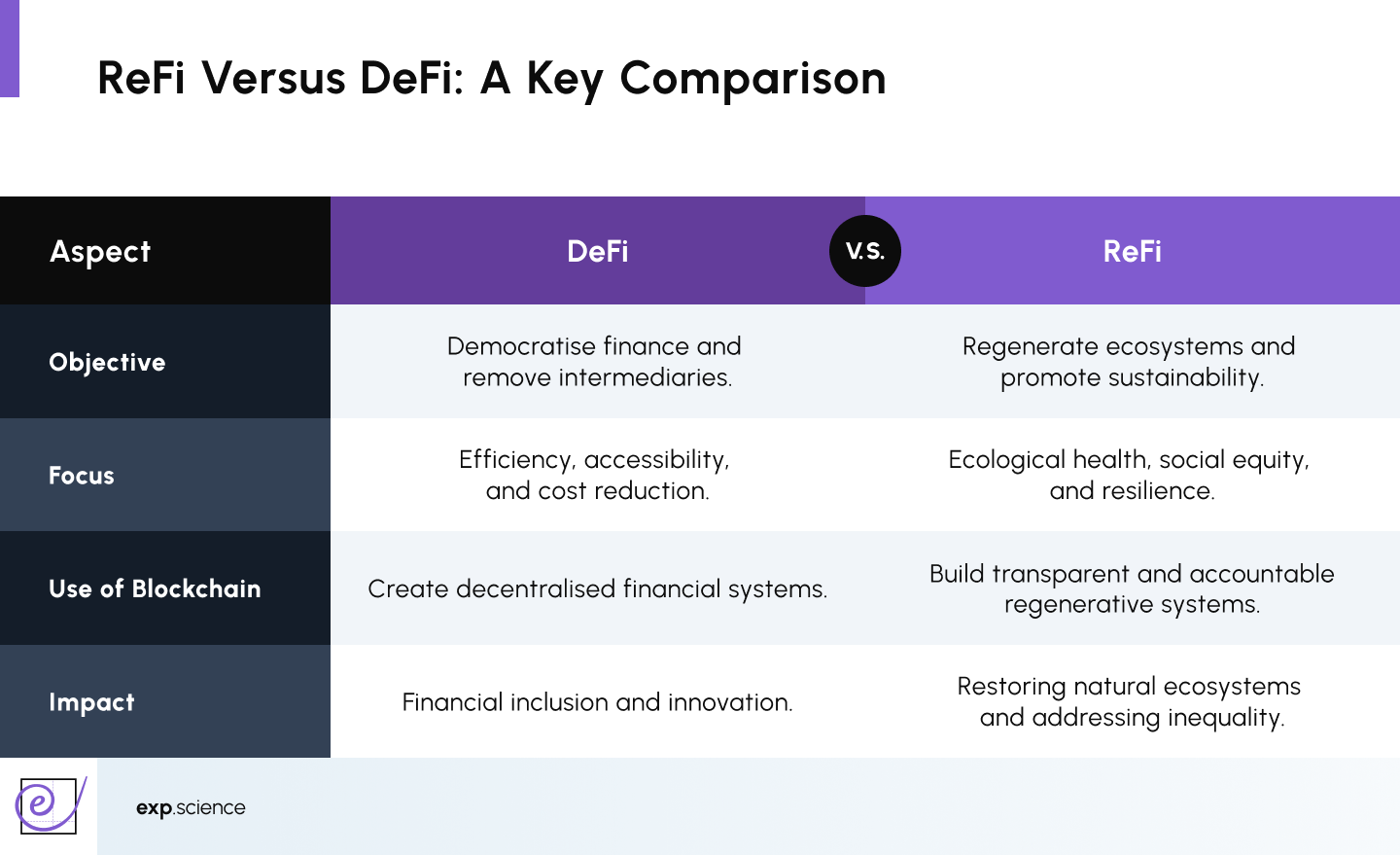
While both decentralised finance and regenerative finance leverage blockchain, they differ substantially in purpose and outcome. The table below highlights key distinctions:
Why ReFi Matters
The world is facing unprecedented challenges, from climate change to economic inequality. Traditional financial systems often exacerbate these issues by prioritising profit over people and the planet. ReFi offers a compelling alternative by:
- Aligning finance with planetary boundaries and sustainability goals
- Empowering communities with inclusive financial tools
- Driving verifiable impact through decentralised technologies
In line with the UN Sustainable Development Goals (SDGs), ReFi systems can fund and track action in areas such as clean energy (SDG 7), reduced inequalities (SDG 10) and climate action (SDG 13). Its capacity to create measurable on‑chain impact positions it as a transformative force in sustainable development and community resilience.
A Culture of Stewardship and Interdependence
ReFi represents a shift not only in technology, but in values by prioritising regeneration over exploitation, stewardship over extraction and cooperation over competition. Rather than presenting impact frameworks in technical isolation, this perspective weaves together principles from doughnut economics, biomimicry and indigenous knowledge systems, underscoring that prosperity is interconnected with ecological health and community well‑being.
This values‑driven mindset invites participation beyond traditional crypto‑native users. Governments, NGOs, researchers and environmental organisations are beginning to explore how ReFi tools can support systemic transformation and complement public‑sector efforts.
ReFi also opens up collaborative models for funding and building public goods. Instead of relying solely on philanthropic donations or top‑down grants, regenerative finance enables community‑driven capital flows that are traceable, democratically allocated and aligned with long‑term impact.
ReFi Ahead: The Next Chapter
Exponential Science is committed to accelerating innovation at the intersection of Web3, sustainability and systems thinking. Through its initiative DLT Earth, it operationalises ReFi principles by:
- Funding verifiable climate and biodiversity projects
- Creating ESG accountability frameworks powered by Hedera
- Facilitating collaboration between scientists, technologists and policymakers
The aim is not merely to support projects, but to ensure that impact is transparent, measurable and owned by communities. By focusing on accountability and scalable tools, DLT Earth and Exponential Science are catalysing the shift from extractive models to regenerative, impact‑driven ecosystems.
Regenerative Finance is a necessary evolution of how value is created and distributed. Its continued success depends on the integration of IoT, AI and blockchain technologies, along with sustained collaboration between governments, academia and Web3 ecosystems. Public understanding and community participation will also be vital to its adoption. Modern-day finance is not just a tool for profit, but can be a driver of change for people, planet and future generations.

.jpg)

.jpg)
.jpg)

