

.jpg)
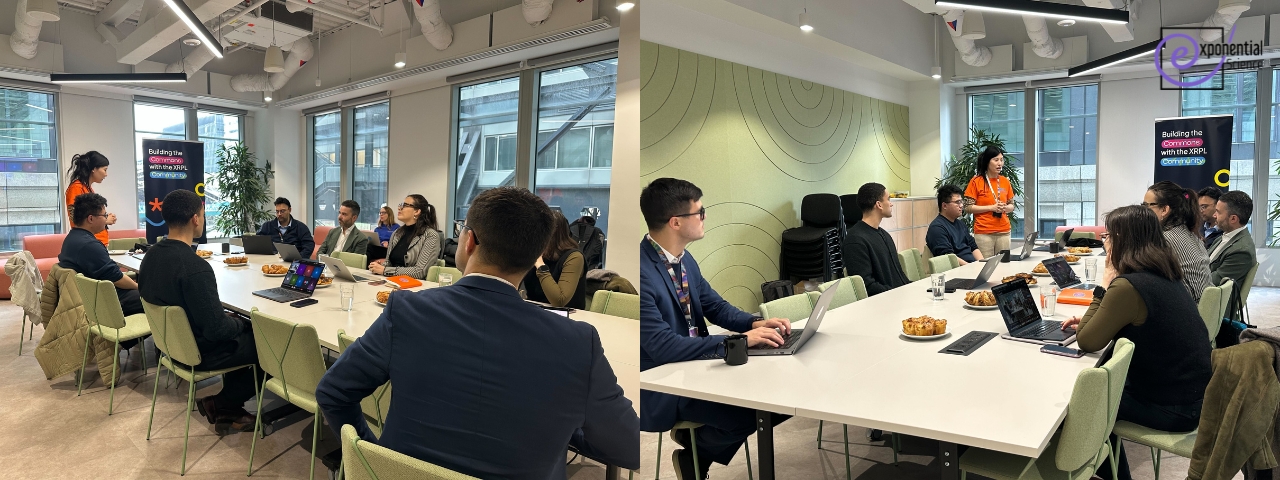
On 18 February 2026, Exponential Science brought together leading researchers, PhD students and industry experts for a hybrid research seminar that explored emerging challenges and advances across the blockchain stack. Hosted in collaboration with the UK Centre for Blockchain Technologies (UK CBT), UCL Centre for Blockchain Technologies (UCL CBT), Ripple and XRPL Commons, the event created a forum for academic insight to intersect with practical implementation.
The seminar covered a broad range of contemporary topics in decentralised technology, linking empirical evidence with real-world system design and market implications. Presenters shared original research, simulation frameworks and analytical findings that contribute to understanding how decentralised systems perform, adapt and evolve in live environments.
Participants presented on key developments across both theoretical and applied domains, including:
- Execution Efficiency on XRPL: A comparative analysis of Automated Market Makers (AMM) and Central Limit Order Book (CLOB) models, with insights into throughput, liquidity and transaction cost dynamics.
- Mitigating MEV Through Delayed Transaction Disclosure: Novel strategies to reduce extractable value and front-running behaviours within permissionless systems.
- AI and Blockchain Integration: A session on how artificial intelligence intersects with distributed ledger technology, exploring opportunities and risk vectors at this junction.
- Taxonomy for Crypto-Assets: Proposals for clearer classification frameworks to support investors and regulators in interpreting token structures and risk profiles.
- Interoperability Frameworks for Decentralised Applications: Formal methods to enable cross-environment compatibility and composability among heterogeneous DApps.
- Decentralised Identity Benchmarking: Empirical results on latency, cost and privacy across identity systems, providing performance baselines for future protocol design.
- Market Design and Network Distortions: Research into liquidity problems, pairing bias and systemic inefficiencies in graph-structured markets.
- DLT-Corpus: Introduction of a large-scale, open corpus for text research in distributed ledger technology, supporting quantitative analysis and NLP applications.
Bridging Research and Real-World Impact
The seminar emphasised the importance of grounding research in practical use cases, reinforcing the role of rigorous academic inquiry in shaping the future architecture of decentralised systems. By linking theoretical frameworks with empirical validation and industry relevance, the event provided a platform where emerging knowledge could inform infrastructure design, market practice and regulatory thinking.
Exponential Science remains committed to fostering research that not only advances foundational understanding but also drives real-world technological progress. The organisation will continue to support collaborative efforts that bring together academia, developers, institutions and ecosystem partners to tackle the most pressing questions in digital finance and decentralised technology.